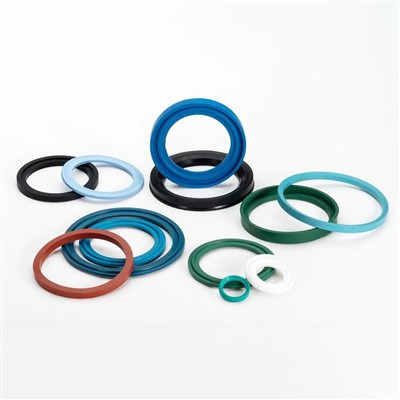
I. Anti - Vibration Mounts
Technical Characteristics:
Dynamic Stiffness Design: It adopts a sandwich structure (metal - rubber - metal). The frequency - sensitivity is regulated by optimizing the vulcanization system of natural rubber (sulfur/Si69 composite vulcanization). The dynamic stiffness range is usually 8 - 25 N/mm², and the damping coefficient tanδ can reach 0.15 - 0.25.
Multi - Axis Vibration Isolation Ability: Utilizing the non - linear hyper - elastic properties of natural rubber, a differential design of dynamic stiffness in the X/Y/Z three directions is achieved (anisotropy ratio 1:0.8:1.2), effectively dealing with complex vibration coupling.
Environmental Adaptability: By adding 3% microcrystalline wax + 1% anti - ozone agent IPPD, the anti - aging performance is enhanced (the performance retention rate is > 85% after 1000 - hour aging according to ASTM D1171).
Application Scenarios:
Industrial Equipment: Vibration isolation for air - compressor bases (The vibration severity according to ISO 10816 is reduced by 60%).
Construction Field: Floating - floor systems in precision - instrument laboratories (The vibration - isolation efficiency is > 30 dB).
Rail Transit: Mounting supports for traction transformers (Meeting the random - vibration standard of 5 - 200Hz in EN 61373).
II. Rubber Buffers
Technical Characteristics:
Energy Dissipation Mechanism: A high - filled system (50 phr N330 carbon black + 15 phr silica) is used. The compression deformation rate (ASTM D395 Method B) is controlled at 20 - 25%, and the rebound rate is > 65%.
Non - linear Stiffness Curve: A three - stage stiffness response is achieved through a multi - cavity structure design (the initial stiffness is 5 N/mm² and increases to 20 N/mm² after the critical point).
Impact Resistance: The drop - hammer impact test (ASTM D2632) shows that the maximum impact - acceleration attenuation rate is > 70%.
Application Scenarios:
Automotive Suspension: Suspension limit blocks (Meeting the 1 - million - cycle fatigue test in SAE J1123).
Elevator System: Buffers at the bottom of elevator cars (The kinetic - energy absorption capacity is > 50 kJ under the EN 81 - 20 standard).
Port Machinery: Anti - collision blocks for container spreaders (Withstanding a 50 - ton dynamic impact load).
III. Suspension Bushes
Technical Characteristics:
Dynamic Hysteresis Control: A blend system of natural rubber/styrene - butadiene rubber (NR/SBR 70/30) is used. The dynamic storage modulus G' (10Hz) is maintained at 1.2 - 1.8 MPa, and the loss factor is 0.08 - 0.12.
Hydraulic Damping Technology: A viscous - fluid cavity (silicone - oil viscosity 5000 cSt) is built - in to achieve additional damping for low - frequency (< 10Hz) vibrations.
Space - Constraint Design: The metal skeleton adopts a powder - metallurgy porous structure (porosity 30%), which improves the rubber - to - metal bonding strength (ASTM D429 Method B > 12 kN/m).
Application Scenarios:
Automotive Control Arms: MacPherson suspension bushes (The NVH performance is improved by 3 dB(A)).
Railway Bogies: Axle - box positioning nodes (The axial stiffness is 25 kN/mm according to the UIC 515 - 4 standard).
Construction Machinery: Connecting bushes for excavator booms (Withstanding working conditions from - 40°C to 80°C).
IV. Suspension Mounts
Technical Characteristics:
Temperature - Compensation Design: A blend of natural rubber/chloroprene rubber (NR/CR 60/40) is used, and the glass - transition temperature Tg is controlled at - 45°C. The stiffness attenuation rate at high temperature (100°C) is < 15%.
Pre - load Adjustment Mechanism: A dished spring (with stiffness - gradient design) is integrated to decouple the static stiffness (20 kN/mm) from the dynamic stiffness (30 kN/mm).
Multi - Physical - Field Coupling: By optimizing the fluid - solid coupling parameters through COMSOL simulation, the damping efficiency of the gas - liquid two - phase is increased by 40%.
Application Scenarios:
Automotive Suspensions: Suspension systems (Meeting the collision conditions in GB 38031).
Wind - Power Equipment: Main - bearing brackets for nacelles (Withstanding 10^8 cycles of load).
Military Equipment: Vehicle - mounted radar - stabilization platforms (The angular - vibration suppression is > 90%).
V. Shock Mounts
Technical Characteristics:
Frequency - Domain Characteristic Regulation: A layered vulcanization process is used. The surface layer is a high - damping layer (tanδ = 0.3), and the core layer is a high - elasticity layer (tanδ = 0.1), achieving wide - frequency vibration isolation in the range of 5 - 500Hz.
Non - linear Damping Characteristics: A magnetorheological unit (MRF - 132DG) is introduced, and the damping force can be continuously adjusted (in the range of 0.5 - 5 kN) through PWM control.
Intelligent Monitoring System: An embedded FBG optical - fiber sensor is used to monitor the strain of the rubber layer in real - time (with an accuracy of ±5με).
Application Scenarios:
Precision Machine Tools: Vibration - damping platforms for lithography machines (The vibration displacement is < 10 nm RMS).
Marine Power: Double - layer vibration - isolation systems for diesel engines (Complying with DNV GL regulations).
Aerospace: Launch - vibration isolation for on - board satellite equipment (Meeting the shock spectrum in MIL - STD - 810G).
VI. Engine Mounts
Technical Characteristics:
Dynamic Decoupling Design: The hydraulic mount adopts a decoupling - membrane structure (EPDM/NR composite membrane). The idle - speed vibration - isolation rate is > 80%, and the structural noise at high frequencies (> 200Hz) is reduced by 15 dB.
Active Control Technology: A piezoelectric actuator (PZT - 5H) is integrated with the rubber body to achieve active harmonic cancellation (control bandwidth 0 - 500Hz).
Multi - Field Durability: Through the HALT test (- 40°C ~ 150°C temperature cycle + 5Grms vibration), the service life is > 10^7 cycles.
Application Scenarios:
Automotive: Engine mounts.
Marine Power: Mounts for V - type 16 - cylinder diesel engines (Bearing a 30 - ton static load).
Aviation Field: Vibration - isolation systems for auxiliary power units (APUs) (Complying with FAA AC 20 - 136B).
Natural rubber is widely used in various vibration - damping products due to its excellent elasticity, durability, and energy - absorption characteristics. From anti - vibration pads, rubber buffers to engine mounts, they play important roles in the automotive, mechanical equipment, construction, and aerospace fields. With the continuous progress of science and technology and the increasing requirements for performance, the application of natural rubber in the vibration - damping field will become more extensive and in - depth.