1. Fluororubber (FKM)
1.1 Chemical Structure and Performance Mechanism
The main chain of fluoro rubber contains C-F bonds (bond energy 485 kJ/mol), and fluorinated groups are introduced into the side chains to form a steric shielding effect. The fluorine content of perfluoro ether - type FKM (FFKM) is over 70%, endowing it with extremely strong chemical inertness.
1.2 Medium Resistance Performance
Oil Resistance: According to ASTM D471 test, in IRM903 oil at 150°C for 70 hours, the volume change rate is less than 5%.
Acid Resistance: It can resist 70% sulfuric acid (23°C) and 50% nitric acid (room temperature), but high-temperature concentrated alkali (such as NaOH > 40%) is likely to cause defluorination reactions.
Wear Resistance: The Taber abrasion loss (CS - 17 wheel, 1 kg load) is about 80 - 120mm³, and it can be reduced to less than 50mm³ by adding PTFE micro powder.
1.3 Modification Technologies
Introduction of the Third Monomer (such as TFE): It improves low - temperature flexibility (TR10 can reach - 30°C).
Reinforcement with Nano - SiO₂: The tear strength is increased by 40% to 50 kN/m.
Perfluoroether Rubber (Kalrez®): The performance of resisting strong acid mixtures is increased by 3 times.
1.4 Typical Applications
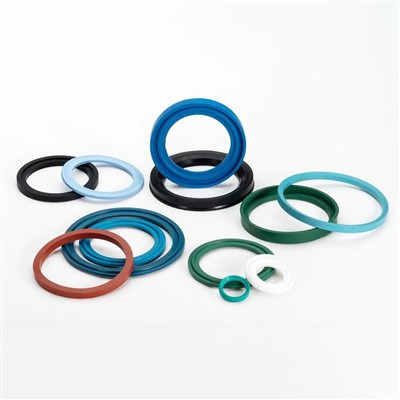
Mechanical seals in refineries (API 682 standard), sealing rings for semiconductor wet etching equipment.
2. Hydrogenated Nitrile - Butadiene Rubber (HNBR)
2.1 Structural Characteristics
After catalytic hydrogenation of nitrile-butadiene rubber, the double-bond saturation is > 95% and the residual double-bonds are < 5%. The Shore A hardness ranges from 55 to 90.
2.2 Performance
Oil Resistance Index: In ASTM#3 oil at 150°C for 168 hours, the volume expansion rate is 8 - 12%.
Chemical Resistance: It has excellent stability in the pH range of 4 - 10 and can resist 50% sulfuric acid (80°C).
Wear-Resistant Characteristics: The abrasion loss tested by DIN53516 is 25 - 40mm³, which is 2 times better than ordinary NBR.
2.3 Formula Optimization
Peroxide Vulcanization System: The cross-linking density is increased to 5×10⁻⁵mol/cm³.
Carbon Fiber Reinforcement: The compression set (150°C×70h) is reduced to 15%.
Silicone Modification: The upper-temperature limit for use is increased to 180°C.
2.4 Application Examples
O - rings in automotive fuel systems (SAE J2643 standard), valve seats for oilfield drilling equipment.
3. Polyurethane Rubber (PU)
3.1 Molecular Design
It has a micro-phase-separated structure of hard segments (MDI/TDI) + soft segments (polyester/polyether). The performance is optimal when the hard-segment content is 40 - 60%.
3.2 Key Performance
Oil Resistance Level: The fuel resistance of polyester-type PU reaches the ASTM D2000 BC level.
Chemical Resistance: It can resist 10% NaOH solution (60°C) and 30% H₂SO₄ (room temperature).
Wear-Resistance Index: The Akron abrasion is less than 0.03cm³/1.61km, which is 10 times that of natural rubber.
3.3 Reinforcement and Modification
Intercalation of Nano-Clay: The tensile strength is increased to 60MPa.
Silicon Carbide Whiskers: The tear strength reaches 120 kN/m.
UV Stabilizer: The outdoor weather resistance is extended to more than 5 years.
3.4 Typical Products
Mine screen meshes (ISO 14890 standard), wear-resistant bushings for hydraulic cylinders.
4. Fluorosilicone Rubber (FVMQ)
4.1 Structural Characteristics
The main chain of silicone - oxygen - alkane (-Si - O -) is combined with trifluoropropyl side chains, which has both flexibility and chemical inertness.
4.2 Performance Parameters
Medium Resistance: It can resist JP - 8 fuel (150°C) with a volume change of less than 15%.
Corrosion Resistance: When resisting 98% concentrated sulfuric acid (23°C×168h), the strength retention rate is > 85%.
Wear-Resistance Index: The value tested by DIN53516 is 40 - 60mm³, and MQ resin needs to be added for reinforcement.
4.3 Composite Modification
Fluorine-Containing Fillers: The oil resistance is increased by 30%.
Plasma Surface Treatment: The bonding strength reaches 4.5MPa.
Thermal Conductivity Modification: The thermal conductivity is increased to 0.8W/mK.
4.4 Application Fields
Sealing parts for spacecraft fuel pipelines (AMS 3327 standard), diaphragms for pumps used in strongly corrosive media.
5. Epichlorohydrin Rubber (ECO)
5.1 Molecular Structure
It is a copolymer of epichlorohydrin, containing polar ether bonds (C - O - C) and chloromethyl groups (-CH₂Cl).
5.2 Characteristic Analysis
Oil Resistance Balance: In the mixture of ASTM oil B/C, the volume change is less than 20%.
Acid and Alkali Resistance: It has good stability in the pH range of 2 - 12.
Dynamic Wear Resistance: The heat generation in the Goodrich flex test is less than 25°C.
5.3 Formula Design
Zinc Oxide/Magnesium Composite Vulcanization: The heat resistance is increased to 130°C.
Graphene Modification: The thermal conductivity is increased to 0.35W/mK.
Ionic Liquid Plasticization: The glass transition temperature is reduced to - 45°C.
5.4 Industrial Applications
Coating layers for printing rollers (hardness 90 ± 5 Shore A), stern shaft seals for ships.
6. Material Performance Comparison and Selection Strategies
| Performance Index | FKM | HNBR | PU | FVMQ | ECO |
|---|---|---|---|---|---|
| Oil Resistance (ΔV%) | < 5 | < 12 | < 15 | < 15 | < 20 |
| Resistance to H₂SO₄ Concentration | 0.7 | 0.5 | 0.3 | 0.98 | 0.4 |
| Wear - Resistance Index (mm³) | 80 - 120 | 25 - 40 | < 30 | 40 - 60 | 50 - 70 |
| Service Temperature (°C) | - 20~230 | - 40~170 | - 50~100 | - 60~250 | - 40~130 |
Selection Principles:
For strong-acid environments, FVMQ or FKM is preferred.
For dynamic wear-resistant components, PU or HNBR is preferably selected.
For cost - sensitive working conditions, modified ECO materials can be considered.
For wide - temperature-range applications, FKM/HNBR blend systems can be used.
Materials such as fluoro rubber and hydrogenated nitrile-butadiene rubber have achieved a coordinated improvement in chemical resistance, oil resistance and wear resistance through molecular design and composite modification. In the future, it is necessary to combine specific working-condition parameters and use multi-scale simulation to guide formula development, so as to promote the innovative application of rubber materials in extreme environments.