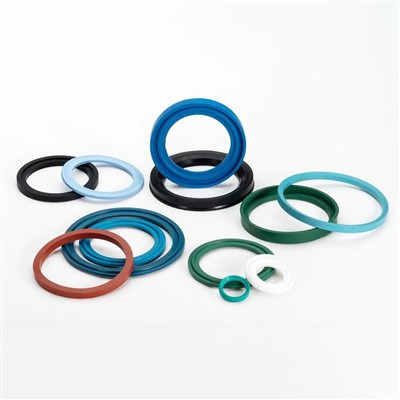
In February 2025, an explosion at the Parker Lord Corporation plant in Pennsylvania injured thirteen workers. While investigations continue, the incident underscores a critical truth: in chemical processing, the smallest component can prevent the largest disaster. Among these critical components, the O-ring stands as the last line of defense against catastrophic failure.

The Hidden Vulnerability: How a $5 Seal Protects Million-Dollar Processes
Chemical plants operate under extreme conditions: corrosive acids, high-pressure steam, cryogenic liquids, and toxic solvents. Every flanged connection, pump shaft, and reactor vessel relies on elastomeric seals-primarily O-rings-to contain these hazardous materials.
When an O-ring fails in a chemical environment, the consequences escalate rapidly. A small leak can release toxic vapors, trigger fires, or cause pressure vessel ruptures. The U.S. Chemical Safety Board (CSB) is currently investigating multiple toxic release incidents from 2024-2025, including nitric acid leaks at Austin Powder facilities, highlighting the ongoing challenge of seal integrity in chemical operations.
Understanding O-Ring Failure in Chemical Environments
O-ring degradation in chemical plants follows three primary pathways:
Chemical Attack: Aggressive chemicals can cause swelling, softening, cracking, or complete dissolution of incompatible elastomers. Concentrated sulfuric acid, for example, will rapidly destroy standard nitrile (NBR) O-rings, while aromatic solvents like benzene attack most hydrocarbon-based rubbers.
Thermal Cycling: Repeated heating and cooling causes elastomers to expand and contract. Over time, this leads to "compression set"-the permanent deformation that prevents the O-ring from maintaining seal pressure. In steam systems cycling between ambient and 150°C, standard rubber compounds fail within months.
Mechanical Stress: Improper installation (twisting, pinching, or over-compression) creates stress concentrations that accelerate crack propagation. Even a correctly sized O-ring can fail if installation procedures are not followed precisely.
Material Selection: Viton vs. FFKM for Chemical Resistance
Selecting the correct O-ring material is not optional-it is a safety-critical engineering decision:
Viton (FKM - Fluorocarbon): The industry standard for general chemical resistance. Viton withstands most acids, petroleum products, and high temperatures (up to 200°C continuous). It is the minimum acceptable material for most chemical processing applications. However, Viton degrades rapidly when exposed to strong bases, amines, or ketones.
FFKM (Perfluoroelastomer / Kalrez): The ultimate chemical-resistant elastomer. FFKM maintains seal integrity across nearly the entire pH spectrum (0-14) and resists virtually all industrial chemicals, including hot concentrated acids and aggressive solvents. Temperature capability extends to 327°C. The trade-off is cost-FFKM O-rings can be 10-20 times more expensive than Viton.
Critical Warning: Using an incompatible O-ring material is not a gradual failure-it can be catastrophic. A nitrile O-ring in concentrated acid will dissolve within hours, not months.
Case Study: The 2021 Yenkin-Majestic Explosion

In April 2021, a catastrophic explosion at the Yenkin-Majestic paint manufacturing facility in Columbus, Ohio, killed one worker and injured several others. The CSB investigation, published in December 2025, identified the root cause: a manway seal failure on a pressure vessel.
The seal was incorrectly designed for the operating pressure and had not been properly tested. When the vessel was pressurized, the seal failed suddenly, releasing flammable vapors that ignited. The explosion destroyed a significant portion of the facility.
This incident demonstrates that seal integrity is not merely a maintenance issue-it is a fundamental safety requirement that demands proper engineering design, material selection, and rigorous testing protocols.
The Most Famous O-Ring Failure: Space Shuttle Challenger
The 1986 Space Shuttle Challenger disaster remains the most well-documented O-ring failure in history. Cold temperatures on launch day caused the solid rocket booster O-rings to lose flexibility, allowing hot combustion gases to escape and breach the external fuel tank.
While aerospace and chemical processing operate in vastly different environments, the lesson is universal: elastomeric seals have defined operating limits. Exceeding those limits-whether through temperature, chemical exposure, or mechanical stress-transforms a reliable component into a catastrophic failure point.

Prevention: Engineering Controls and Maintenance Protocols
Preventing O-ring failure in chemical plants requires a systematic approach:
♤ Material Compatibility Verification: Consult chemical resistance charts before specifying any seal. When in doubt, test sample O-rings in the actual process fluid.
❅ Scheduled Replacement: Establish replacement intervals based on operating conditions, not visual inspection alone. High-temperature or chemically aggressive environments require proactive replacement every 12-24 months.
♤ Installation Training: Ensure maintenance personnel understand proper O-ring installation techniques, including lubrication, groove inspection, and torque specifications.
❅ Quality Sourcing: Specify O-rings from manufacturers with documented material certifications and traceability. Counterfeit or substandard seals are a known problem in industrial supply chains.
♤ Leak Detection Systems: Implement continuous monitoring for early detection of seal degradation before catastrophic failure occurs.
In chemical processing, there are no "minor" seal failures. Every O-ring is a critical safety barrier. Proper material selection, rigorous installation procedures, and proactive replacement schedules are not optional-they are the foundation of safe chemical plant operations.