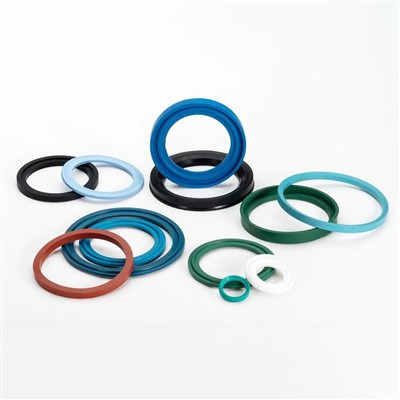
As global hydrogen infrastructure investment surpasses $300 billion, fuel cell systems face unprecedented sealing challenges. Operating from cryogenic -253°C to high-pressure 70 MPa conditions, hydrogen applications demand advanced materials where conventional seals fail catastrophically within hours.

Why Hydrogen Demands Advanced Sealing Materials
Hydrogen's unique molecular properties create sealing challenges that conventional elastomers cannot survive. With the smallest molecular size of any element, hydrogen permeates through standard rubber materials, causing degradation, swelling, and explosive decompression failures.
The hydrogen economy's rapid expansion-with over 5,000 new refueling stations planned globally by 2028-has made seal integrity a critical safety barrier. In fuel cell systems, a single seal failure at 700 bar pressure isn't merely an efficiency problem; it's a potential catastrophe.
Three Critical Failure Mechanisms
Seal degradation in hydrogen applications follows three primary pathways:
Hydrogen Embrittlement: Hydrogen molecules permeate elastomers at the molecular level, causing blistering, cracking, and explosive decompression. Standard NBR O-rings fail within hours in high-pressure hydrogen service, while FFKM offers 10-100x lower permeation rates.
Cryogenic Brittleness: Liquid hydrogen storage at -253°C causes standard elastomers to lose all flexibility and shatter upon mechanical stress. Only specialized materials like PTFE and modified PEEK maintain sealing capability at these extreme temperatures.
Rapid Pressure Cycling: Hydrogen refueling stations compress gas to 70 MPa in under 3 minutes, creating thermal shock and pressure fluctuations that cause seal extrusion and dimensional instability. Materials must survive millions of cycles without degradation.
Material Selection Guide
Selecting the correct sealing material for hydrogen service is a safety-critical engineering decision:
FFKM (Perfluoroelastomer): The gold standard for hydrogen sealing. FFKM delivers 10-100x lower hydrogen permeation than standard FKM and maintains seal integrity from -15°C to +327°C. Essential for fuel cell stack seals, high-pressure valve stems, and electrolyzer gaskets. Service life exceeds 10 years in hydrogen environments where NBR fails within weeks. The trade-off is cost-FFKM seals are 15-30x more expensive than NBR.
Spring-Energized PTFE Seals: The only viable solution for liquid hydrogen storage and transfer at -253°C. These hybrid seals combine a chemically inert PTFE jacket with a metal spring core that maintains sealing force as materials contract in extreme cold. PTFE's dense molecular structure blocks hydrogen diffusion completely.
HNBR (Hydrogenated Nitrile): A balanced choice for moderate-pressure applications. Operating from -40°C to +150°C and suitable for pressures up to 35 MPa, HNBR is 3-5x cheaper than FFKM while delivering approximately 80% of the performance. Preferred for fuel cell vehicle seals and medium-pressure storage systems.
Real-World Applications
High-Pressure Refueling Stations: Operating at 70 MPa (700 bar), these systems require FFKM valve seals and PTFE backup rings to prevent hydrogen leakage during rapid compression cycles. Seal failures at these pressures can result in explosive releases.
Cryogenic Storage Systems: Liquid hydrogen transport and storage at -253°C demands spring-energized PTFE seals for pump shafts and transfer couplings. Standard elastomers become brittle as glass at these temperatures.
Fuel Cell Vehicles: PEM fuel cell stacks use FFKM gaskets to seal bipolar plates and prevent hydrogen crossover. HNBR seals are typically used in balance-of-plant components where temperatures and pressures are moderate.
Market Outlook
The hydrogen sealing materials market is experiencing unprecedented growth. Industry analysts project the global market for hydrogen-compatible seals will reach $2.8 billion by 2030, representing a 28% compound annual growth rate from 2026 levels.
Key drivers include the EU's 2030 target of 40 GW electrolyzer capacity, China's "Hydrogen Cities" initiative, and heavy transport manufacturers including Hyundai, Nikola, and Daimler launching hydrogen fuel cell fleets. Steel, cement, and chemical industries are transitioning to hydrogen-based processes, creating demand for industrial-scale sealing solutions.
"The hydrogen economy will only succeed if we solve the sealing challenge. A single leak in a 700-bar refueling station isn't just an efficiency problem-it's a safety crisis. That's why OEMs are now specifying FFKM and PTFE as non-negotiable standards."
- Chief Engineer, Hydrogen Mobility Division, Xiamen Best Seal
Best Practices for Seal Reliability
Preventing seal failure in hydrogen applications requires rigorous engineering protocols:
Material Qualification Testing: All seals must undergo ISO 19881 and SAE J2579 certification testing for hydrogen compatibility. Never assume material suitability without documented validation.
Permeation Rate Verification: Measure hydrogen permeation rates under actual operating conditions. FFKM compounds vary significantly-some formulations offer 100x better performance than others.
Installation Precision: Hydrogen seals require precise installation procedures including proper lubrication with hydrogen-compatible greases, torque specifications to prevent over-compression, and groove inspection for damage or contamination.
Scheduled Replacement: Establish replacement intervals based on pressure cycles and temperature exposure, not visual inspection. High-pressure hydrogen service typically requires seal replacement every 2-5 years regardless of appearance.
Leak Detection Systems: Implement continuous hydrogen leak monitoring using electrochemical sensors. Early detection prevents catastrophic failures and enables proactive maintenance.
The hydrogen economy will only succeed if we solve the sealing challenge. A single leak in a 700-bar refueling station is not just an efficiency problem-it's a safety crisis. Proper material selection, rigorous testing, and proactive maintenance are the foundation of safe hydrogen infrastructure.
• ⑅ˏ͛- Xiamen Best Seal Hydrogen Solutions☆.*