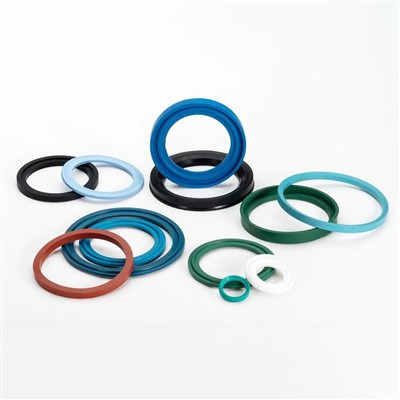
Below are the four major application categories where O-rings play a vital role:
1️⃣ Automotive Industry
O-rings are used throughout vehicle systems to ensure airtight and leak-proof connections.
Common applications include:
- Engine oil seals
- Brake systems
- Cooling systems
- Fuel delivery systems
- Air conditioning lines
💡 Recommended materials: NBR, FKM (Viton®), EPDM
Typical hardness: 70–90 Shore A


2️⃣ Industrial Machinery
In heavy-duty industrial environments, O-rings maintain performance under high pressure, temperature, and chemical exposure.
Typical uses:
Hydraulic cylinders
Pneumatic systems
Pumps and compressors
Valves and actuators
💡 Recommended materials: NBR, FKM, HNBR
Typical hardness: 75–90 Shore A
3️⃣ Medical & Food Equipment
O-rings made from FDA-grade or medical-grade silicone are used in equipment requiring high purity and biocompatibility.
Examples:
Medical devices
Laboratory instruments
Food processing machinery
Beverage dispensers
💡 Recommended materials: Silicone (VMQ), FFKM, EPDM (FDA-approved)
Typical hardness: 50–70 Shore A


4️⃣ Plumbing & Water Systems
Used in everyday plumbing and water-related applications, O-rings ensure reliable sealing and long-term durability.
Typical examples:
Bathroom Faucets
Showerheads
Toilet Flush Systems
Water Purifiers
💡 Recommended materials: EPDM, Silicone, NBR
Typical hardness: 60–80 Shore A
✅ Summary
From automobiles to household plumbing, O-rings are indispensable for maintaining system reliability.
Choosing the right material and hardness based on temperature, pressure, and chemical exposure is key to ensuring optimal performance and service life.