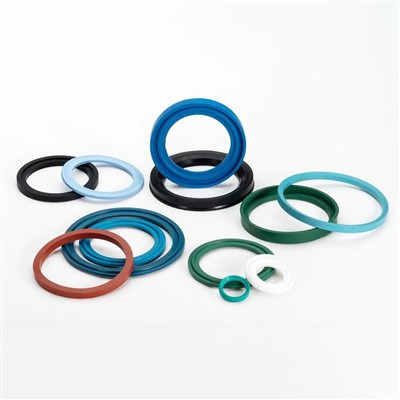
During hot summer weather, managing rubber seal inventory and maintaining operating machinery requires special attention. Rubber is a temperature-sensitive polymer; high ambient heat, combined with humidity and seasonal ozone, accelerates polymer aging, causing premature hardening and leakage.
For procurement managers stocking inventory and maintenance teams servicing active machines, hot weather poses distinct challenges. Implementing correct storage environments and preventative maintenance routines during the summer months prevents expensive equipment shutdowns and maximizes the service life of your seals.

1. Warehouse Storage: Defending Against Heat, Light, and Ozone
To protect unused O-rings, gaskets, and hydraulic seals in storage from chemical degradation during summer heat waves, follow these four rules:
- Temperature Control (Keep under 25°C): The rate of chemical reactions (such as cross-linking aging) doubles for every 10°C rise in temperature. Store seals in a cool, ventilated area or air-conditioned room below 25°C. Keep rubber parts away from direct heaters or boiler walls.
- Flat Storage (Do Not Hang): High ambient temperatures soften rubber compounds. Hanging O-rings or V-rings on hooks, nails, or pegs causes concentrated stress at the contact point. Over time, the seal takes a permanent tension set (deformation) and will leak when installed. Always store seals flat in their original box or bag.
- Ozone and Light Shielding: Summer smog increases ground-level ozone. Ozone attacks unsaturated bonds in rubber (like NBR or natural rubber), causing "ozone cracking." Keep seals in opaque bags or closed bins. Never store seals near high-voltage motors, electric generators, welding equipment, or mercury vapor lamps, which release ozone.
- Humidity Management (Under 70% RH): Keep relative humidity below 70% in the storage facility. High humidity under warm temperatures can cause condensation, leading to fungal growth or hydrolysis (chemical breakdown by water) in polyurethanes.
2. Active Equipment Maintenance: Protecting Operational Seals
For machinery operating outdoors or in uncooled factories during the summer, preventive maintenance keeps seals functioning under heavy thermal load:
- Lubrication Replenishment: Extreme heat reduces the viscosity of oils and greases, causing them to thin out and run. If a dynamic seal runs dry, localized friction heat can push temperature interfaces beyond 150°C, burning the seal lip. Regularly check and top up lubricant reservoirs with compatible greases.
- Cleanliness and Dirt Exclusion: Summer dust and grit stick easily to rubber seals softened by heat. In reciprocating hydraulic rods, these particles can get trapped under the wiper lip and score the rod or tear the seal. Clean these areas regularly.
- Flange Bolt Torque and Thermal Cycling: Materials expand at different rates in summer heat. Metal flanges and bolts expand, compressing gaskets. When the system cools down (thermal cycling), the gasket can experience compression relaxation, leading to gaps. Inspect and torque bolts to specifications to ensure a constant seal load.
3. Warning Signs: Spotting Heat Degradation Early
During routine summer maintenance inspections, watch for these signs of elastomeric damage:
- Hardening and Cracking: The rubber loses its flexibility and cracks when bent, indicating excessive cross-linking.
- Softening or Stickiness: The polymer surface becomes tacky or gummy, indicating chain scission (molecular breakdown).
- Glazing: The sealing lip of a dynamic rotary shaft seal develops a shiny, hard, polished surface. This occurs when friction heat "vulcanizes" the surface layer, leaving it unable to trace shaft runout.
Summer Seal Storage & Maintenance Checklist
| Storage Factor | Target Specification | Risk if Ignored |
|---|---|---|
| Temperature Limit | Store below 25°C, away from direct heat sources. | Accelerated aging, premature hardening. |
| Mechanical State | Store flat in boxes or sealed bags. Do not hang on pegs. | Permanent deformation, tension set. |
| Ozone & Light Shield | Store in opaque bags. Keep away from electric motors and UV lamps. | Ozone cracking, oxidation. |
| Air Lubrication | Apply heat-stable grease periodically on active dynamic seals. | Dry running, friction heat, glazed lips. |
Supporting Your Inventory with Xiamen Best Seal
At Xiamen Best Seal, our commitment to quality begins in our climate-controlled raw material warehouse and extends to the final protective packaging of our finished components:
- Controlled Storage & Packaging: All molded components are packaged flat in opaque, heavy-duty PE bags immediately after post-curing and inspection to seal out light, dust, and ozone.
- Traceability & FIFO Inventory: We strictly follow IATF 16949 quality standards and utilize a first-in, first-out (FIFO) inventory control system, ensuring that raw elastomers do not sit exposed to warehouse aging.
- Custom Material Formulation: For systems facing extreme summer temperatures, our in-house lab can compound specialized heat-stabilized EPDM, high-fluorine FKM, or high-tensile HNBR to extend your machinery's service life.
🛠️ Explore Related Storage & Design Guides:
- Rubber Seal Shelf Life Storage Guide: Industrial storage standards (ARP5316).
- FKM vs. EPDM Chemical Resistance: Compare temperature and environmental performance.
- Calculate Rubber Seal Compression Force: Physics of seal compression and deformation.
Optimizing your warehouse storage or experiencing early seal failures in hot machinery? Contact Xiamen Best Seal today for professional technical support, material compound recommendations, and rapid custom molding services.
• Xiamen Best Seal • Precision Elastomer Storage & Maintenance Guidelines •