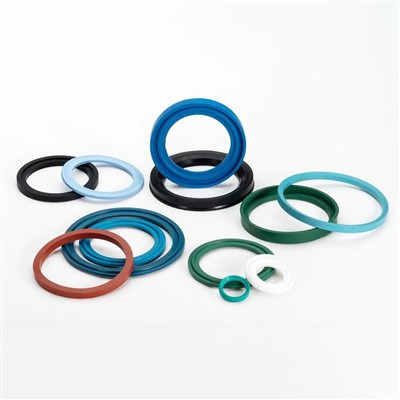
In food, beverage, dairy, pharmaceutical, and medical manufacturing, O-rings, gaskets, and custom diaphragms do far more than prevent leaks. They are direct-contact components that must withstand aggressive Clean-in-Place (CIP) chemicals, extreme sterilization temperatures, and strict biological safety audits. Specifying a rubber component that fails sanitary regulatory compliance can lead to toxic extraction, product contamination, and catastrophic recalls.
Understanding the differences between FDA, 3-A Sanitary, and USP Class VI standards is crucial for B2B engineering and procurement teams. In this guide, we break down these three critical benchmarks and how to choose the right material for your sanitary application.

1. FDA CFR 21 177.2600: The Baseline for Food Contact
The U.S. Food and Drug Administration (FDA) sets the foundational standard for materials intended for repeated contact with food. Specifically, FDA CFR 21 177.2600 governs "Rubber articles intended for repeated use."
To achieve FDA compliance, an elastomer compound must satisfy two main criteria:
- Permitted Ingredients List: The compound must be formulated using only the specific elastomers, vulcanizing agents, accelerators, plasticizers, and fillers listed in the FDA regulation.
- Extraction Limits: The finished rubber article must pass rigorous extraction tests. When exposed to distilled water and n-hexane at reflux temperatures, the extractable fractions must remain below strict limits (e.g., max 20 mg/sq inch in water for the first 7 hours, and max 1 mg/sq inch in subsequent hours).
Note: FDA compliance is a self-certification standard. There is no official "FDA Certificate" issued by the agency. Instead, reliable manufacturers perform independent laboratory testing to verify extraction compliance and provide a Declaration of Compliance.
2. 3-A Sanitary Standards: The Dairy and Liquid Food Benchmark
While FDA regulations establish chemical safety, they do not address the physical design and cleanability of the equipment. This is where 3-A Sanitary Standards step in. Developed by the dairy industry, 3-A standards are widely adopted across the food, beverage, and personal care sectors.
For rubber components, 3-A Standard 18-03 (Multiple-Use Rubber and Rubber-Like Materials) is the governing specification. It builds on FDA requirements with several strict additions:
- Surface Finish and Geometry: Materials must have extremely smooth, non-porous surfaces. They must be designed to eliminate crevices, sharp corners, or pockets where bacteria can lodge and multiply.
- Clean-in-Place (CIP) Resistance: 3-A compounds are subjected to simulated cleaning and sanitizing procedures. They are exposed to hot alkaline cleaners, acid sanitizers, chlorine, and steam, and must not swell, lose hardness, or degrade significantly.
- Classifications: Materials are categorized into Class I, II, III, or IV based on their fat resistance and cleaning cycle survivability, with Class I being the most robust.
3. USP Class VI: The Biocompatibility Standard for Pharma and Biotech
The United States Pharmacopeia (USP) is a non-profit organization that establishes quality standards for medicines and medical devices. Elastomers used in pharmaceutical processing, biotech fluid handling, and medical implants must undergo USP testing to prove biocompatibility and low toxicity.
Elastomer testing is divided into six classes (Classes I through VI), with USP Class VI being the most comprehensive and stringent. USP Class VI certification requires three direct biological reactivity tests on animal subjects:
- Systemic Injection Test: Evaluates systemic toxicity when extracts of the rubber material are injected into the subject.
- Intracutaneous Test: Evaluates localized skin reactions or irritation.
- Implantation Test: Evaluates physical tissue reactions to direct contact with the elastomer over an extended period.
USP Class VI elastomers guarantee that no harmful chemicals will leach from the seal into pharmaceutical fluids, active ingredients, or the human body.
Comparing the Standards: FDA vs. 3-A vs. USP Class VI
The table below highlights the key differences, testing focuses, and typical applications for each of the three major sanitary standards:
| Standard | Core Testing & Requirement Focus | Typical B2B Application |
|---|---|---|
| FDA CFR 21 177.2600 | Chemical composition validation and water/hexane extraction testing. | General food packaging, dry food handling, household appliances. |
| 3-A Sanitary (18-03) | Surface cleanability, sanitary geometric design, and intense CIP chemical resistance. | Dairy processing, draft beer dispensers, liquid beverage bottling. |
| USP Class VI | In-vivo biological reactivity, systemic toxicity, and tissue compatibility. | Biotech bioreactors, pharmaceutical filling lines, medical syringes. |
Sanitary Elastomer Selection Guide
Choosing the right standard is only half the battle; you must also select a base elastomer that withstands your process operating conditions:
Silicone (VMQ) / Platinum-Cured
Extremely low extractables, outstanding high/low temperature flexibility, and excellent biocompatibility. Preferred for USP Class VI pharmaceutical tubing and sanitary food-grade gaskets.
EPDM (Ethylene Propylene)
Outstanding resistance to hot water, sanitizing steam, and aggressive polar CIP acid/alkali chemicals. Ideal for 3-A compliant dairy lines and sanitary process piping.
FKM (Viton)
Superb resistance to fats, oils, organic solvents, and high continuous process temperatures. Recommended for food processing involving edible oils and high-temperature filling.
PTFE / FFKM (Perfluoroelastomer)
Maximum chemical inertness and near-universal compatibility. Best for extremely aggressive CIP cycles and high-purity pharmaceutical manufacturing.
Why Partner with Xiamen Best Seal for Sanitary Solutions?
At Xiamen Best Seal, we elevate sanitary sealing from a simple commodity to a precision B2B engineering process.
- ISO & TÜV Certified Production: Our manufacturing facility operates under a rigorous Quality Management System certified to ISO 9001 and verified by TÜV, ensuring total material traceability.
- Certified Compounds: We provide independently tested, fully certified rubber compounds matching FDA CFR 21 177.2600 extraction limits, 3-A Sanitary Standards, USP Class VI biocompatibility, and Reach-RoHS directives.
- Premium Cleanroom Capabilities: For ultra-purity pharmaceutical and medical-grade rubber parts, we utilize cleanroom compression molding and double PE-bagged packaging to eliminate airborne particulate contamination.
◉ Explore Compliance-Grade Sanitary Products:
- Food-Grade Silicone Sealing Rings: Precision-molded VMQ rings for heat and pressure cookers.
- Reach & RoHS Compliant Seals: Environmentally safe and compliant elastomers.
- FDA Silicone Rubber Balls: Pure silicone check-valve balls for fluid processing.
Need assistance selecting the right sanitary rubber material for your machinery? Contact Xiamen Best Seal today for engineering support, material formulation assistance, and rapid prototyping of certified sanitary gaskets and O-rings.
• Xiamen Best Seal • Precision Sanitary Sealing Solutions •