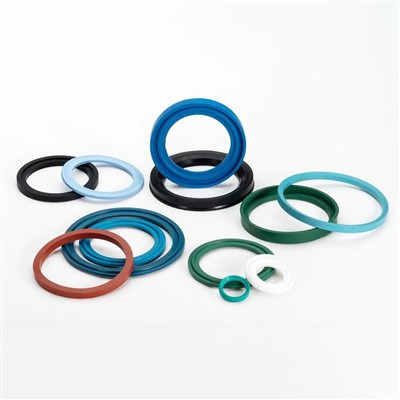
Vulcanization is a critical process in rubber product manufacturing, during which rubber macromolecules form a three-dimensional network structure through cross-linking reactions, thereby gaining essential properties such as elasticity, strength, and heat resistance. However, in actual production, issues like uneven vulcanization, product deformation, and surface defects often arise due to factors such as process parameter fluctuations, mold design flaws, and material performance differences. This article analyzes typical problems in rubber vulcanization molding and provides corresponding solutions.
I. Uneven Vulcanization
Phenomenon
Different parts of the same product exhibit significant differences in hardness, elasticity, or mechanical properties. For example, the edge of a seal ring is over-vulcanized (hard and brittle), while the inner part is under-vulcanized (soft and sticky).
Main Causes
Uneven mold temperature: Poor thermal conductivity of the mold or blocked cooling channels leads to temperature differences in different areas (exceeding ±5°C).
Uneven product thickness: Thick-walled parts have slow heat transfer, resulting in under-vulcanization, while thin-walled parts are prone to over-vulcanization.
Unreasonable rubber flow: Complex product structures cause uneven distribution of rubber in the mold cavity, with stagnant areas experiencing prolonged vulcanization.
Inconsistent pressure: Uneven clamping force of the vulcanizing machine leads to uneven pressure distribution in the mold.
Solutions
Optimize mold temperature control:
Use a multi-zone temperature control system for the mold, with each zone's temperature deviation controlled within ±2°C.
Clean the mold's cooling water channels regularly to ensure smooth water flow (water pressure ≥0.2MPa).
For large molds, install thermal conductive inserts (e.g., copper alloys) in low-temperature areas.
Improve product design:
Avoid excessive thickness differences (the ratio of maximum to minimum thickness should not exceed 3:1).
Add transition arcs or gradient structures at the junction of thick and thin parts.
Adjust vulcanization parameters:
Adopt stepwise temperature rise vulcanization (e.g., first 150°C for 2 minutes, then 160°C for 5 minutes) to balance the vulcanization degree of thick and thin parts.
Increase the pressure of the vulcanizing machine appropriately (for rubber with high viscosity, pressure can be increased by 10-15%).
Optimize mold structure:
Set overflow grooves in areas prone to over-vulcanization to reduce rubber retention.
Design reasonable runners and gates to ensure uniform rubber filling.
II. Product Deformation
Phenomenon
After demolding, the product deviates from the design size, such as warping of gaskets, bending of rubber hoses, or shrinkage of O-rings.
Main Causes
Uneven internal stress: Uneven cross-linking density during vulcanization leads to residual internal stress, which is released after demolding.
Unreasonable demolding timing: Demolding too early (under-vulcanization) or too late (over-vulcanization) causes shape instability.
Poor mold release design: Lack of draft angles, rough mold surfaces, or unreasonable parting lines increase demolding resistance and cause deformation.
Shrinkage mismatch: Differences in shrinkage rates between rubber and embedded metal parts (e.g., in rubber-metal composites) lead to warping.
Solutions
Reduce internal stress:
Use a slow cooling process after vulcanization (cooling rate ≤5°C/min) to release stress gradually.
Add 1-2 phr of processing aids (e.g., stearic acid) to improve the fluidity of the rubber compound and reduce molding stress.
Control demolding timing:
Determine the optimal demolding time based on the vulcanization curve (t90 + 10-20% as the standard).
For large products, use delayed demolding (maintain pressure for 1-2 minutes after vulcanization is complete).
Optimize mold design:
Set a reasonable draft angle (≥3° for rubber, ≥5° for rubber with fillers).
Polish the mold cavity to a surface roughness Ra ≤0.8μm and apply a release agent (e.g., silicone oil) evenly.
Adjust the formula and process:
For rubber-metal composites, select rubber with a shrinkage rate close to that of metal (e.g., EPDM with low shrinkage for aluminum inserts).
Pre-treat metal inserts (e.g., sandblasting or phosphating) to enhance bonding force and reduce relative movement.
III. Surface Defects
Phenomenon
Surface problems such as bubbles, pits, scorch marks, or flow lines appear on the product, affecting appearance and sealing performance.
Main Causes
Air entrapment: Air in the rubber compound or mold cavity is not discharged in time, forming bubbles after vulcanization.
Impurities or contamination: Foreign matter (e.g., dust, metal particles) in the rubber compound or mold causes surface pits.
Overheating: Local high temperature (exceeding the thermal stability temperature of the rubber) leads to scorch marks.
Poor rubber fluidity: Low-temperature or high-viscosity rubber results in uneven flow, forming flow lines or cold shuts.
Solutions
Eliminate air entrapment:
Use a vacuum vulcanization process (vacuum degree ≥-0.09MPa) for products with high surface requirements.
Add vent grooves (depth 0.1-0.2mm, width 3-5mm) at the end of the mold cavity's rubber flow path.
Pre-degas the rubber compound (stand at 60°C for 2 hours) before molding.
Strengthen contamination control:
Clean the mold cavity with alcohol or a dedicated cleaning agent before each vulcanization cycle.
Install a metal detector in the rubber feeding system to remove hard impurities.
Use a closed mixing system to avoid dust contamination.
Prevent overheating:
Check the mold's heating system regularly to avoid local overheating (e.g., short circuits in electric heating tubes).
Reduce the vulcanization temperature appropriately (by 5-10°C) for rubber with poor thermal stability (e.g., natural rubber).
Improve rubber fluidity:
Add 3-5 phr of processing oil (e.g., naphthenic oil) or flow promoters (e.g., polyethylene wax) to the formula.
Preheat the rubber compound to 50-60°C before molding to reduce viscosity.
IV. Under-Vulcanization or Over-Vulcanization
Phenomenon
Under-vulcanization: The product is soft, has low strength, sticky surface, and large compression set (exceeding 30%).
Over-vulcanization: The product is hard and brittle, has reduced elongation at break, and may have surface cracks.
Main Causes
Inappropriate vulcanization parameters: Incorrect temperature, time, or pressure settings (e.g., temperature too low/time too short leads to under-vulcanization; temperature too high/time too long leads to over-vulcanization).
Unstable vulcanizing machine performance: Fluctuations in the machine's actual temperature (deviation >±10°C) or pressure (deviation >±5%) affect the vulcanization effect.
Changes in rubber compound performance: Differences in the Mooney viscosity or vulcanization activity of the rubber compound between batches lead to mismatched vulcanization parameters.
Solutions
Optimize vulcanization parameters:
Determine the optimal vulcanization time (t90 + 10%) through a rheometer test (e.g., using a moving die rheometer MDR).
Set the vulcanization temperature based on the rubber type: natural rubber 140-150°C, nitrile rubber 150-160°C, fluororubber 170-180°C.
Stabilize equipment performance:
Calibrate the vulcanizing machine's temperature and pressure sensors monthly (accuracy ±1°C for temperature, ±1% for pressure).
Maintain the machine's hydraulic system to ensure stable clamping force.
Control rubber compound quality:
Test the vulcanization curve of each batch of rubber compound and adjust the vulcanization time accordingly (e.g., increase time by 10% for rubber with slower vulcanization speed).
Strictly control the storage time of the rubber compound (natural rubber compound should be used within 72 hours at room temperature).
V. Practical Production Optimization Measures
Adopt intelligent vulcanization control:
Install an online vulcanization monitoring system to track the real-time temperature and pressure in the mold, and automatically adjust parameters.
Use a mold with built-in thermocouples to monitor the actual temperature of the rubber during vulcanization.
Strengthen mold maintenance:
Establish a mold maintenance schedule (polish the cavity every 500 vulcanization cycles, replace wearing parts every 5,000 cycles).
Apply a wear-resistant coating (e.g., titanium nitride) to the mold surface to extend its service life.
Standardize operation procedures:
Formulate a detailed SOP (Standard Operating Procedure) for vulcanization, including mold preheating time (≥30 minutes), clamping force, and demolding timing.
Train operators to identify early signs of vulcanization defects (e.g., sticky surfaces indicating under-vulcanization, brittle edges indicating over-vulcanization).
The quality of rubber vulcanization molding depends on the coordination of mold design, process parameters, material performance, and equipment status. By targeting the root causes of common problems and implementing the above solutions, enterprises can significantly improve product qualification rates, reduce production costs, and enhance market competitiveness.